
Most people entering HYROX ask one simple question:
“Is my HYROX time good for my age?”
It’s a fair question.
A 25-year-old competing in the Open division should not expect the same finish time as a 55-year-old Masters athlete.
Yet most HYROX time discussions online ignore age completely.
The reality is simple.
Performance changes gradually across decades due to differences in:
- aerobic capacity
- running economy
- recovery speed
- repeat power output
But here’s the good news.
HYROX is one of the most age-friendly competitive fitness races.
Because the event blends endurance, strength, and pacing strategy, experienced athletes often outperform younger competitors who rely purely on raw fitness.
In this guide you’ll see:
- realistic HYROX age-group benchmark times
- how performance typically shifts across decades
- what counts as Elite, Advanced, Strong, Average, and Beginner
- how to judge your result accurately
And most importantly…
- what you should realistically aim for in your age group.
- Most HYROX athletes finish between 1:25 and 1:55 depending on age and division.
Competitive results typically fall between:
- 1:05–1:20 for athletes under 40
- 1:15–1:35 for athletes over 40
Masters athletes regularly finish under 1:30, showing that experience and pacing play a major role in HYROX performance.
Key Findings: HYROX Age Group Benchmarks
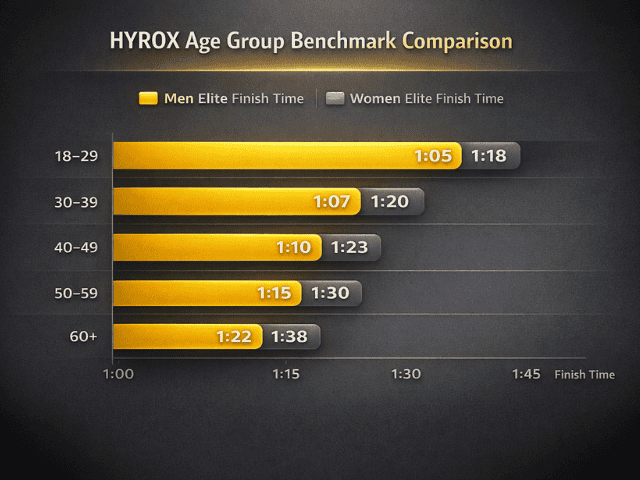
The tables below show realistic performance bands by age group for the Open division.
These match the benchmark standards used in the HYROX Times guide, which acts as the central performance reference on HYROXY.
HYROX Men Age Group Performance Benchmarks
| Age Group | Elite | Advanced | Strong | Average | Beginner |
|---|---|---|---|---|---|
| 18–29 | Under 1:05 | 1:05–1:15 | 1:15–1:25 | 1:25–1:40 | 1:40+ |
| 30–39 | Under 1:07 | 1:07–1:17 | 1:17–1:28 | 1:28–1:43 | 1:43+ |
| 40–49 | Under 1:10 | 1:10–1:20 | 1:20–1:32 | 1:32–1:47 | 1:47+ |
| 50–59 | Under 1:15 | 1:15–1:27 | 1:27–1:40 | 1:40–1:55 | 1:55+ |
| 60+ | Under 1:22 | 1:22–1:35 | 1:35–1:50 | 1:50–2:05 | 2:05+ |
HYROX Women Age Group Performance Benchmarks
| Age Group | Elite | Advanced | Strong | Average | Beginner |
|---|---|---|---|---|---|
| 18–29 | Under 1:18 | 1:18–1:28 | 1:28–1:40 | 1:40–1:55 | 1:55+ |
| 30–39 | Under 1:20 | 1:20–1:32 | 1:32–1:45 | 1:45–2:00 | 2:00+ |
| 40–49 | Under 1:23 | 1:23–1:36 | 1:36–1:50 | 1:50–2:05 | 2:05+ |
| 50–59 | Under 1:30 | 1:30–1:45 | 1:45–2:05 | 2:05–2:25 | 2:25+ |
| 60+ | Under 1:38 | 1:38–1:55 | 1:55–2:15 | 2:15–2:40 | 2:40+ |
👉 See the full benchmark breakdown in our HYROX Times guide
How HYROX Age Groups Work
HYROX competitions separate results by age-group divisions to create fair competition.
Age categories include:
- 18–29
- 30–39
- 40–49
- 50–59
- 60+
Every athlete still completes the exact same race format:
- 1km Run
- SkiErg
- 1km Run
- Sled Push
- 1km Run
- Sled Pull
- 1km Run
- Burpee Broad Jumps
- 1km Run
- Row
- 1km Run
- Farmers Carry
- 1km Run
- Sandbag Lunges
- 1km Run
- Wall Balls
Only the leaderboards and podiums are separated by age.
This is why comparing your result to the correct age group is so important.
HYROX Performance Percentiles by Age Group
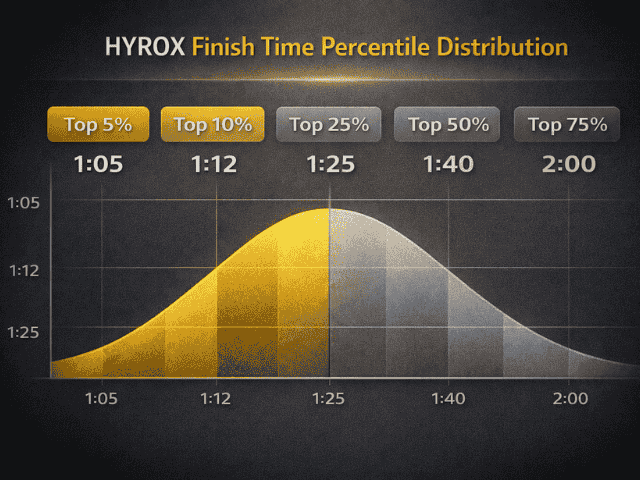
Finish-time benchmarks tell you whether your result is Elite, Advanced, Strong, Average, or Beginner.
Percentiles show something different.
They tell you how your time compares to the wider field of athletes.
For example:
- Top 10% means you are faster than 90% of competitors.
- Top 25% means you outperform three-quarters of the field.
This gives a clearer picture of where you truly stand.
Approximate HYROX Performance Percentiles (Open Division)
| Percentile | Finish Time |
|---|---|
| Top 5% | Under 1:05 |
| Top 10% | Under 1:12 |
| Top 25% | Under 1:25 |
| Top 50% | Under 1:40 |
| Top 75% | Under 2:00 |
These ranges vary slightly by race location and course flow, but they provide a realistic overview of the competitive field.
To explore this in more detail, see:
That guide includes the full percentile breakdown used across HYROXY benchmarks.
Why Percentiles Matter More Than Average Times
Average finish times can be misleading.
For example, many HYROX races have large numbers of first-time athletes, which pushes the average time higher.
Percentiles provide a better performance indicator because they show how competitive your result actually is.
For example:
| Finish Time | Percentile | Interpretation |
|---|---|---|
| 1:05 | Top 5% | Elite field performance |
| 1:15 | Top 10% | Highly competitive |
| 1:30 | Top 25% | Strong performance |
| 1:45 | Top 50% | Around race median |
| 2:05 | Bottom 25% | Beginner level |
This is why most experienced HYROX athletes track percentile ranking rather than average time.
How Age Groups Influence Percentiles
Age categories affect where athletes fall within the percentile distribution.
Younger divisions typically have:
- faster average run speeds
- deeper competitive fields
- higher elite density
Masters divisions often have:
- slightly slower average finish times
- more experience-based pacing
- smaller competitive fields
But strong masters athletes frequently still rank inside the top 20–30% of the overall race field.
That’s why the most accurate comparison is always:
Your time vs your age-group benchmarks.
How to Benchmark Your Result
Let’s say you finish a HYROX race in 1:28.
You can analyse that result in three ways:
Division benchmark
In the Open division, 1:28 falls inside the Strong performance band.
Age-group benchmark
For men aged 30–39, this time sits around the Strong / Average threshold.
Percentile
A 1:28 finish usually places athletes roughly in the top 25–30% of the field.
Using all three views gives a much clearer understanding of performance.
Pro Tip: The Most Useful Metric for Improving HYROX Times
The best athletes don’t just track finish time.
They track station splits and pacing consistency.
For example:
- if your running pace slows dramatically after Station 4
- or if wall balls take twice as long as the benchmark
you’ve identified where time is leaking.
Use the guide below to analyse your race in detail:
→ HYROX Station Split Benchmarks
What Is a Good HYROX Time for Each Age Group?
Age 20–39
Strong results typically fall between 1:10 and 1:30.
Age 40–49
Strong results usually fall between 1:15 and 1:40.
Age 50+
Strong finishes typically range from 1:25 to 1:55 depending on experience.
How Age Actually Affects HYROX Performance
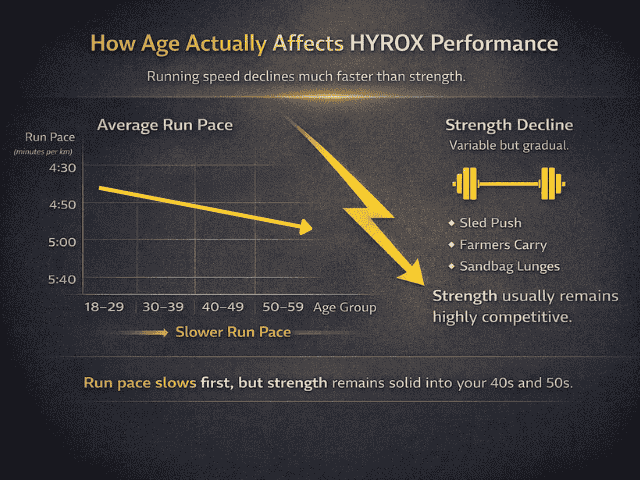
Age influences HYROX performance — but not always in the way people expect.
The biggest difference comes from running speed, not strength.
Running Speed Declines First
HYROX contains 8 kilometres of running.
Even small changes in pace create large differences in total race time.
| Run Pace | Total Running Time |
|---|---|
| 4:30 / km | ~36 minutes |
| 5:00 / km | ~40 minutes |
| 5:30 / km | ~44 minutes |
A 30-second drop in pace adds roughly four minutes to your race time.
Because of this, running ability remains the biggest predictor of HYROX performance.
Strength Declines Much Slower
Stations such as:
- Sled Push
- Farmers Carry
- Sandbag Lunges
rely heavily on strength endurance, which tends to decline more gradually with age.
This is why experienced athletes can remain competitive well into their 40s and 50s.
Why Masters Athletes Often Perform So Well in HYROX
HYROX rewards efficiency as much as fitness.
Older athletes frequently outperform younger competitors because they:
- pace their runs more evenly
- avoid early station burnout
- minimise RoxZone transition time
- manage wall ball sets intelligently
These decisions often save 3–5 minutes across the race.
Common Time Leaks for Older HYROX Athletes
Age rarely determines race outcomes on its own.
Most slower finish times come from avoidable mistakes.
Starting the Race Too Fast
Many athletes match the early pace of faster runners.
The result:
- heart rate spikes
- lactate accumulates
- later stations become dramatically harder
A controlled opening pace usually leads to a faster overall result.
Wall Ball Burnout
Wall balls are the final station and often the biggest race killer.
Athletes who attempt very large early sets frequently end up resting for long periods.
Smaller controlled sets typically produce faster completion times.
Slow RoxZone Transitions
The RoxZone is where athletes transition between running and stations.
Many competitors waste 2–4 minutes total here through slow walking or inefficient station entry.
Those minutes are easy to lose and surprisingly difficult to recover.
How To Improve Your HYROX Time at Any Age
Regardless of age, three factors make the biggest difference to performance.
1. Protect Your Running Pace
Running accounts for the largest share of your race time.
If your pace collapses after the middle stations, your finish time will increase dramatically.
Consistent pacing almost always beats aggressive early speed.
2. Train Station Efficiency
HYROX rewards athletes who can maintain steady output while fatigued.
Training combinations such as:
- run → sled push
- run → burpee broad jumps
- run → wall balls
build the ability to perform stations under race fatigue.
3. Reduce Transition Time
Small improvements in RoxZone efficiency compound across the race.
Saving 10–15 seconds per transition can remove several minutes from your finish time.
What Is a Good HYROX Time for Your Age?
For most athletes in the Open division:
- Sub-90 minutes is considered a strong finish
- Sub-75 minutes is highly competitive
- Sub-60 minutes represents elite-level racing
But age matters.
A 90-minute finish in the 50+ division is extremely impressive.
To see the full benchmark breakdown across divisions and percentiles, visit:
FAQ
What is a good HYROX time for a 40-year-old?
For most athletes aged 40–49, finishing between 1:20 and 1:47 is considered strong depending on gender and experience.
Competitive athletes often aim to finish under 1:30.
Can older athletes compete in HYROX?
Yes. HYROX includes age-group divisions up to 70+, and masters athletes regularly produce highly competitive performances.
Does age change the HYROX race format?
No.
Every competitor completes the same course consisting of 8 runs and 8 workout stations.
Only rankings are separated by age group.
Wrap Up
Age influences HYROX performance — but far less than many athletes assume.
Because the race combines endurance, strength, and pacing strategy, experienced competitors often maintain impressive results well into their 40s and beyond.
The key is understanding where your time is gained or lost.
Benchmark your performance against realistic standards, improve station efficiency, and protect your running pace.
That approach delivers the biggest improvements at any age.