

HYROX Pro vs Open Times 2026
You’re not choosing between “easy” and “hard”.
You’re choosing between two completely different race profiles.
Quick answer
- The structure stays the same (8 × 1km runs + 8 stations)
- Pro increases the fatigue cost at key stations
- That changes your pacing, transitions, and overall race execution
If you compare Pro and Open times without adjusting for that, you’ll misread your performance.
Should You Choose Pro or Open? (Read this first)
Choose Open if:
- your pace drops after halfway
- sled push disrupts your run
- wall balls are still a grind
- you rely on runs to recover
Choose Pro if:
- you’re consistently in the top 15–20% of Open
- your running holds under fatigue
- your stations feel controlled, not chaotic
- your transitions are efficient
One line:
If your race still feels like survival, stay in Open.
If it feels controlled, you’re close to Pro.
If you’re unsure where you actually sit, compare your result against realistic HYROX age group times
Key Findings
- Pro changes the race flow, not the distance
- The biggest differences come from sled push, sled pull, carries, lunges and wall balls
- Running gets compromised earlier in Pro
- Small inefficiencies (10–30s per segment) can cost minutes overall
- You must compare results using division-specific benchmarks
What actually changes between HYROX Open and Pro
The structure is identical:
- 8km running
- 8 stations
- same order
The only difference:
👉 The fatigue demand per station
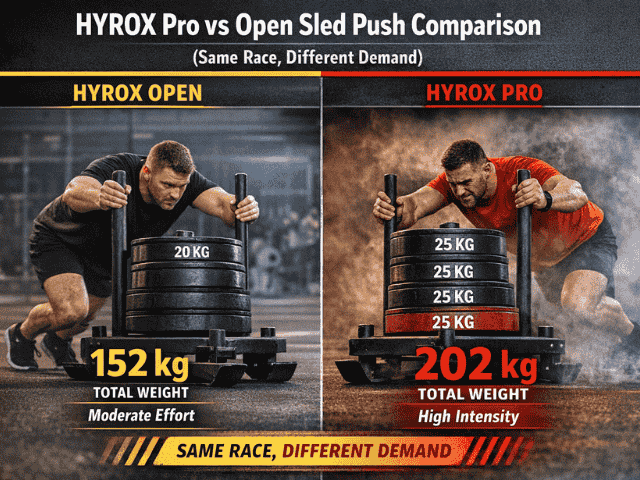
HYROX Open vs Pro: Official weight differences (2026)
| Station | Women Open | Women Pro | Men Open | Men Pro |
|---|---|---|---|---|
| Sled Push | 102kg | 152kg | 152kg | 202kg |
| Sled Pull | 78kg | 103kg | 103kg | 153kg |
| Farmer Carry | 2 × 16kg | 2 × 24kg | 2 × 24kg | 2 × 32kg |
| Sandbag Lunges | 10kg | 20kg | 20kg | 30kg |
| Wall Balls | 4kg | 6kg | 6kg | 9kg |
This is where the race changes.
Not in theory.
In fatigue.
Why Pro feels like a different race
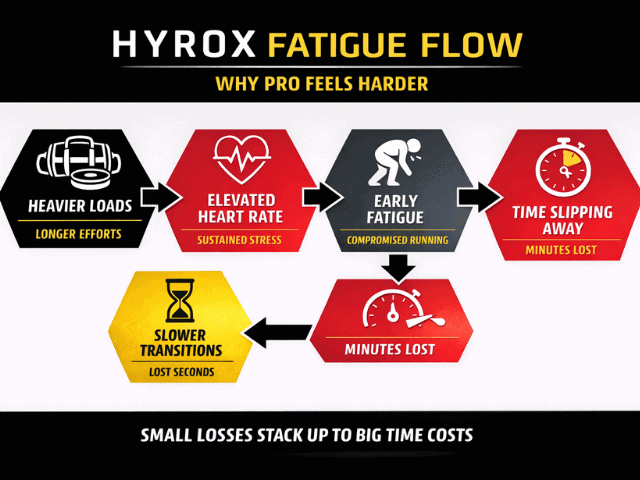
On paper, it’s heavier.
In reality, it’s harder to manage.
What actually happens
- You spend longer under load
- Your heart rate stays elevated longer
- Your next run slows earlier
- Your transitions become less efficient
This is how time disappears.
And you’ve already seen this:
👉 Even 10–30 seconds lost per segment
→ becomes 2–4 minutes across the race
If you haven’t looked at this properly, review your detailed HYROX station split benchmarks
That’s where your real gaps show up.
The real difference: compromised running
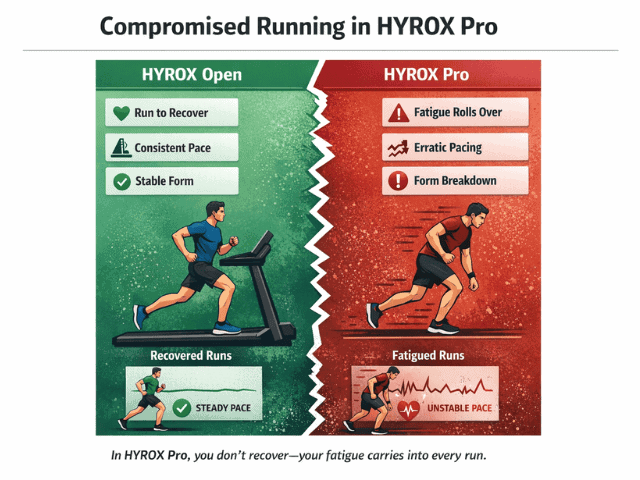
This is the biggest shift between Open and Pro.
In Open:
- you can recover on runs
In Pro:
- recovery disappears quickly
- pacing becomes unstable
- fatigue carries forward
That’s why people say:
“My running felt fine… until halfway.”
Most people don’t struggle in Pro because they’re not fit enough.
They struggle because they move up before they can control their race.
If your pacing collapses under fatigue, your structure is usually the issue how to structure your HYROX running programme
How to compare HYROX Pro vs Open times properly
Stop comparing raw times across divisions.
It doesn’t work.
Correct comparison
- Open → Open benchmarks
- Pro → Pro benchmarks
If you haven’t checked this properly yet, start here at the complete HYROX times and benchmarks guide
HYROXY benchmark system (stay consistent)
Men Open
- Elite: <1:05
- Advanced: 1:05–1:15
- Strong: 1:15–1:25
- Average: 1:25–1:40
Women Open
- Elite: <1:10
- Advanced: 1:10–1:25
- Strong: 1:25–1:40
- Average: 1:40–2:00
Men Pro
- Elite: <60
- Advanced: 60–68
- Strong: 68–75
- Average: 75–90
What this actually means
A 1:15 finish time:
- Strong in Men Open
- Not elite in Men Pro
- Competitive in Pro Women
Same number.
Different context.
If you’re unsure where you actually sit, use what is a good HYROX time by division
Where Pro actually costs you time
Not evenly.
The big three
Sled Push
- longest effort under load
- biggest impact on next run
If this station slows your race, fix it using how to improve your HYROX sled push performance
Sled Pull
- grip fatigue
- inefficient movement = big losses
Wall Balls
- fatigue accumulation
- broken sets
- missed reps
If this is your limiter, improve here ultimate HYROX wall balls guide
Secondary impact
Farmer Carry
- grip + breathing control
Sandbag Lunges
- posture fatigue
- leg burn affecting running
Lower structural change
- SkiErg
- Row
- Burpee Broad Jumps
Still affected — but more pacing-driven.
Reality check: why most people move to Pro too early
Most athletes move up for the wrong reason.
- one good Open race
- boredom
- ego
Not performance.
What happens next
- pacing breaks early
- stations take longer
- running collapses
- results look worse
And worse:
👉 You learn the wrong lessons.
What happens if you move to Pro too early
- You redline earlier than expected
- You lose control of pacing
- Your weakest station dominates the race
- You stop improving efficiently
It feels like progress.
It isn’t.
How to train differently for Pro
This is where you actually improve.
If you’re not already doing this, your move to Pro will stall.
1) Train compromised running
Not fresh intervals.
Instead:
- run after sleds
- run after lunges
- run under fatigue
2) Fix your biggest time leak
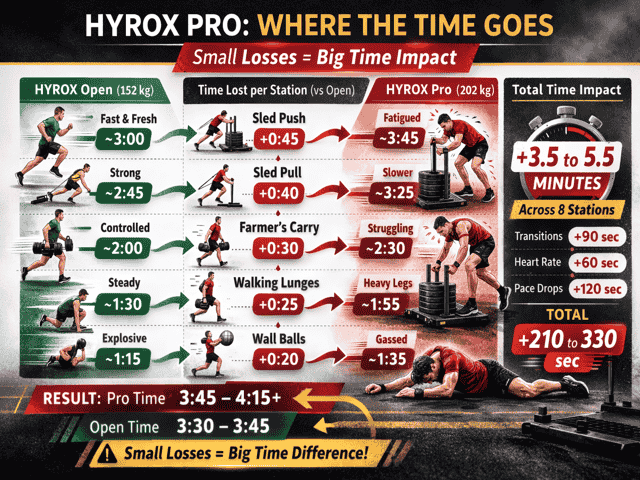
Use your splits.
Go back to your HYROX station split benchmarks and target times
Don’t train everything.
Fix what costs you minutes.
3) Control RoxZone
This is free time if you get it right.
Train:
- transitions
- setup habits
- breathing resets
4) Build grip and durability
Pro exposes:
- forearms
- shoulders
- core
Lose grip → lose time everywhere.
Pro tip: think in time leaks, not fitness
Writing
Stop asking:
“How do I get fitter?”
Start asking:
- Where am I losing 60–90 seconds?
- Which station ruins my next run?
- Where do I hesitate?
That’s where your result is decided.
How this fits into your HYROX progression
This is your turning point.
You move from:
👉 “What’s a good time?”
→ to
👉 “How do I improve my time?”
From here, your next step is clear:
Follow a structured approach like the 6 week HYROX training plan
Common mistakes when moving to Pro
- pacing like Open
- ignoring transitions
- underestimating sled fatigue
- relying too much on running
- moving up too early
Fix these and you progress properly.
What you should do next
If you’re serious about improving:
- Check your HYROX times and benchmarks
- Compare your division properly
- Review your station split performance breakdown
- Identify your biggest time leak
- Fix that first
If you want a clearer breakdown:
👉 Use your time alongside your benchmarks
👉 Then build your plan from there
Want to know if you’re ready for Pro?
If you’re unsure:
- your time alone isn’t enough
- your splits tell the real story
Use your time, your splits, and your pacing to diagnose your race properly.
Wrap up
HYROX Pro vs Open is not about ego.
It’s about race dynamics.
- Same structure
- Same distance
- Completely different fatigue demands
Understand that, and you’ll:
- choose the right division
- train smarter
- improve faster
Ignore it, and you stall.
FAQs
Is Pro harder than Open?
Yes — because of increased load and fatigue cost per station.
Should I compare Pro and Open times directly?
No. Always compare within your division.
When should I move to Pro?
When your Open performance is controlled and repeatable.
Can beginners do Pro?
They can — but it’s not the fastest way to improve.
Final thought
Don’t move to Pro to prove something.
Move to Pro when your performance already proves it.
That’s how you keep progressing.