

Quick Answer — What a HYROX Running Programme Actually Needs
Most HYROX running programmes fail for one reason:
They train running in isolation.
HYROX running isn’t about speed.
It’s about holding your pace under fatigue.
A proper HYROX running programme must train:
- Compromised running (after stations, not fresh)
- Pacing control (so you don’t blow up early)
- Repeatability (same pace across all 8 runs)
If your splits fade every lap, this is your limiter.
Fix this…
…and your HYROX time moves fast.
👉 Before changing anything, start with a full breakdown of your HYROX times and what they actually mean so you know exactly what’s holding you back.
⚡ Key Findings (Read This First)
- HYROX running fails due to fatigue mismanagement, not lack of fitness
- Training running fresh doesn’t transfer to race day
- Most people destroy their race in the first 2km
- Running improvements compound across every station and transition
- Fixing running can save you minutes, not seconds
⚠️ Before You Commit
This plan only works if running is the part of your race that breaks first.
If your pace mainly falls apart after sleds, lunges or wall balls, your problem may not be running at all.
Quick check:
- you run reasonably well fresh
- your splits collapse after stations, not before them
- your legs feel heavy because the workout wrecked you first
👉 In that case, start with the HYROX Performance System
Fix the right limiter first.
Then come back and use this programme properly.
This Is Not a Normal Running Plan

If you’re expecting:
- tempo runs
- intervals
- long slow distance
That’s not enough.
HYROX running is different because:
- you’re never fresh
- your heart rate is already elevated
- your legs are already fatigued
So if your plan doesn’t include running under fatigue…
…it’s not a HYROX running programme.
It’s just a running plan.
And that’s exactly why it doesn’t transfer.
If your runs fall apart after stations, start here.
Get the 14-Day HYROX Kickstart and fix the running that actually breaks in your race.
A Complete 4-Week HYROX Running Programme (Running Limiter Focus)
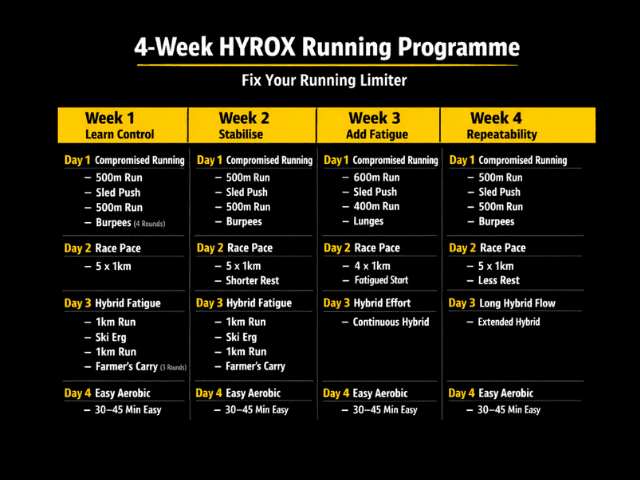
Programme Structure
| Day | Focus | Purpose |
|---|---|---|
| Day 1 | Compromised Running | Train fatigue resistance |
| Day 2 | Race Pace Control | Lock in sustainable pace |
| Day 3 | Hybrid Fatigue | Connect running + stations |
| Day 4 | Easy Aerobic | Support recovery |
Week 1 — Learn Control
Day 1 — Compromised Running
4 rounds:
- 500m run
- sled push
- 500m run
- burpees
2–3 min rest
Day 2 — Race Pace Control
5 × 1km
60–90 sec rest
Day 3 — Hybrid Fatigue
3 rounds:
- 1km run
- ski erg
- 1km run
- farmer’s carry
Day 4 — Easy Aerobic
30–45 mins easy
Week 2 — Stabilise
- reduce rest slightly
- improve pacing consistency
- smoother transitions
Week 3 — Add Fatigue Pressure
Day 1
5 rounds:
- 600m run
- sled push
- 400m run
- lunges
Day 2
4 × 1km
start each rep fatigued (lunges / burpees first)
Day 3
continuous hybrid effort
Day 4
easy aerobic
Week 4 — Build Repeatability
Day 1
same as Week 1 — less rest
Day 2
5 × 1km — same pace, less rest
Day 3
long hybrid flow
Day 4
easy aerobic
Progression Rule (Critical)
⚠️ This decides whether you improve or stall.
- If your pace drops → you progressed too early
- If your pace holds → progress
Simple.
But most ignore it.
🔁 Re-Test Your Running Under Fatigue
After a few weeks of this work, check if it’s actually improving your race.
👉 Check your HYROX time again
If your running splits are improving but your overall time is not:
you’re likely limited somewhere else.
👉 Go back to the HYROX Performance System
and reassess your main limiter
🚨 Diagnose Your Running (Don’t Guess)
Running is your limiter if:
- splits fade every lap
- pace collapses after stations
- later runs feel like survival
If your runs are not the part breaking first, and the real damage starts on sleds, lunges or wall balls, HYROX strength endurance is probably your real limiter.
If running is your main fix, keep this block. But if you need to place it into a full week without wrecking your recovery, use this weekly HYROX training plan structure.
👉 Confirm it properly using a full HYROX time breakdown and race analysis
How Much Time You Can Gain
Running affects:
- every lap
- every transition
- every recovery
If your running fades…
everything slows.
Fix it…
…and everything improves.
Where Most Athletes Go Wrong (And Why You’re Not Improving)
You’re doing:
- running ✔
- strength ✔
- conditioning ✔
Looks right.
It isn’t.
Because your training isn’t aligned with your limiter.
👉 This is exactly why most people stall — they train everything, but fix nothing.
Start here:
How to improve your HYROX time by fixing your biggest limiter first
The training plan on this page only works if running is actually your limiter.
Why Your Running Falls Apart in HYROX
It’s Not Fitness — It’s Transition Fatigue
You’re not just running.
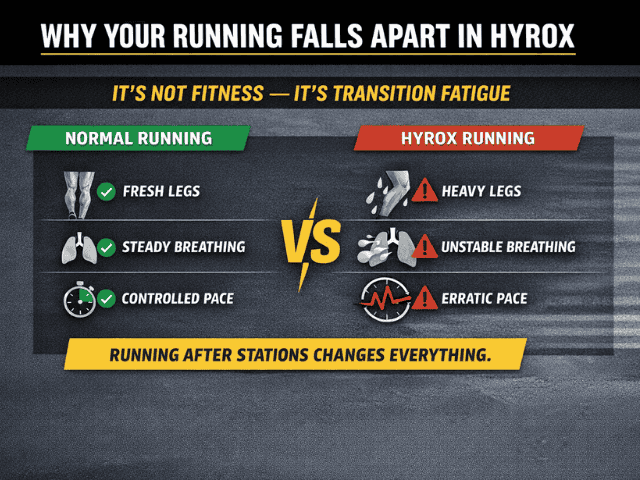
You’re running:
- after sled push
- after lunges
- after wall balls
- with unstable breathing and heavy legs
That changes everything.
- your stride shortens
- your breathing spikes
- your pacing judgement disappears
That’s why your “good runner” fitness doesn’t show up.
You’re Training Running in the Wrong State

Most people train:
- fresh
- controlled
- predictable
HYROX is none of those.
Race conditions are:
- elevated heart rate
- muscular fatigue
- disrupted rhythm
If you don’t train that state…
…you can’t perform in it.
You Don’t Know Your Race Pace
This is the biggest silent limiter.
You think you’re pacing well.
You’re not.
You’re:
- going out too hard
- reacting to others
- chasing splits
Then your race collapses halfway.
👉 If you don’t know what your pace should look like, anchor it against what a good HYROX time looks like for your division.
The 3 Types of Running You Must Train for HYROX
You don’t need more running.
You need the right types.
1. Compromised Running (After Stations)
📉 This is where races are won or lost.
What it is:
Running immediately after fatigue.
Why it matters:
This is how you race.
Example:
4 rounds:
- 500m run
- sled push
- 500m run
- burpee broad jumps
Focus:
- regain control quickly
- stabilise breathing
- hold pace
2. Race Pace Running (Control, Not Speed)
🎯 Most people get this wrong.
What it is:
Learning your repeatable HYROX pace.
Example:
5–6 × 1km
60–90 sec rest
Rules:
- same pace every rep
- no drop-off
- finish controlled
3. Aerobic Support (Without Overdoing It)
🧠 Useful — but not the driver.
What it is:
Low-intensity support work.
Common mistake:
Relying on it too much.
It supports performance.
It doesn’t drive it.
🧠 The HYROX Running System
- Anchor your pace
- Train compromised
- Build repeatability
- Fix your limiter first
No fluff.
Just execution.
Want the simplest next step from here?
Use the 14-day Kickstart to turn this advice into a clear week-by-week starting block.
📈 What To Do Next
Start here:
- understand your HYROX time
- identify your limiter
- apply this programme
👉 Then build your full structure using a proven HYROX training plan designed around your limiter
If Your Running Falls Apart Late, Check Your Shoes Too
Your fitness still matters most.
But if your shoes are too soft, unstable or poor on grip, they can make every station cost more energy and every run harder to hold.
For HYROX running under fatigue, your shoe needs:
- enough cushioning for repeated 1km efforts
- enough grip for sled push and pull
- enough stability when your legs are tired
If your shoes are fine but your hands are the issue on sled pull or farmer carry, compare the best gloves for HYROX as a secondary race-day support option.
👉 See the best shoes for HYROX if running is your limiter
FAQs
How often should I run for HYROX?
3–4 times per week if it’s your limiter.
Should I prioritise running or strength?
Whichever costs you the most time.
If you’re unsure, compare your performance against HYROX station split benchmarks and where you’re losing time
Can I improve running without losing strength?
Yes — if you manage volume and avoid junk training.
Final Reality Check
You don’t need:
- more running
- more effort
You need:
- better pacing
- better fatigue control
- better execution
If running is no longer the real problem and your race is still falling apart, fix that next with this HYROX pacing strategy guide.
Fix that…
…and your next HYROX race looks completely different.