

Quick Answer — What HYROX Strength Endurance Actually Means
You’re not slow because you’re weak.
You’re slow because your strength doesn’t hold under fatigue.
HYROX strength endurance is your ability to produce force repeatedly across the entire race:
- not fresh
- not rested
- not once
If your stations fall apart, this is your limiter.
Fix this…
…and your gym strength finally shows up when it matters.
👉 Before changing anything, start with a proper breakdown of your HYROX times and what they actually mean — then use How to Improve Your HYROX Time to confirm whether stations are actually the problem.
⚡ Key Findings
- HYROX strength endurance is not max strength
- Stations fail when force drops under fatigue, not because you cannot lift enough fresh
- Sleds, lunges and wall balls punish poor repeatability, not lack of power
- If your stations break your rhythm, this is likely your limiter
- Diagnose first, then train — not the other way around
⚠️ Before You Commit
This block works best when stations are the part of your race costing you the most time.
If your running pace fades early, your effort is chaotic, or you feel cooked before the station work really starts, this may not be your main limiter.
Quick check:
- your runs are steady enough, but stations break your rhythm
- lunges, wall balls or sled work spill into the run after
- your strength is there fresh, but not repeatedly under fatigue
👉 If that sounds mixed rather than clear, start with the HYROX Performance System
Fix the right limiter first.
Then come back and train this properly.
This Is Your Limiter If…
This page is for you if:
- you feel decent on runs but stations wreck your race
- sled push feels manageable early but brutal later
- wall balls break into messy sets fast
- lunges crush your legs and ruin the run after
- you’re “strong in the gym” but that strength disappears in-race
This Is Not Your Main Fix If…
- your running fades harder than your stations
- your pacing is chaotic from the first 2–3km
- your transitions are where you leak the most time
If you’re not sure…
Don’t guess.
👉 Go back to your HYROX Times guide first, then use How to Improve Your HYROX Time to classify your limiter properly.
Why You’re Strong… But Still Slow on Stations
Strength Without Endurance Fails Fast
You can:
- squat heavy
- deadlift strong
- push decent numbers
HYROX does not care about that alone.
Because in-race:
- you don’t get full recovery
- the effort is continuous
- fatigue compounds
- movement quality degrades
Strength shows up early.
Strength endurance shows up when the race is trying to break you.
You’re Not Training Under Fatigue
This is where most people get it wrong:
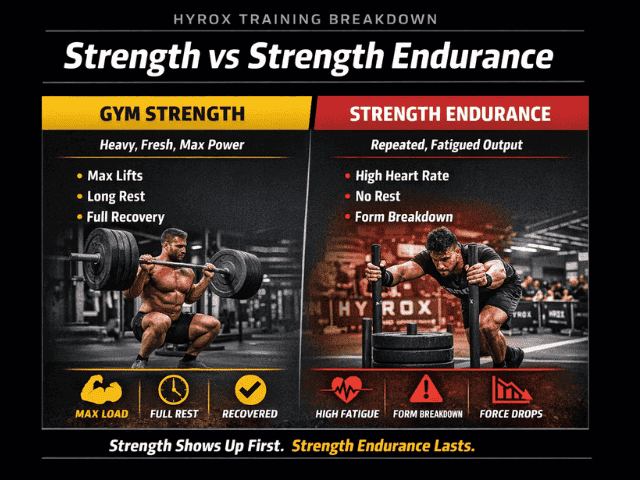
Gym strength shows up fresh.
HYROX strength endurance is what’s left when fatigue is already high.
Most gym training looks like:
- heavy sets
- long rest
- clean reps
- controlled breathing
HYROX looks like:
- high heart rate
- minimal recovery
- messy transitions
- repeated output under pressure
If you don’t train in that state…
…your strength will not transfer.
Stations Stack — They Don’t Reset
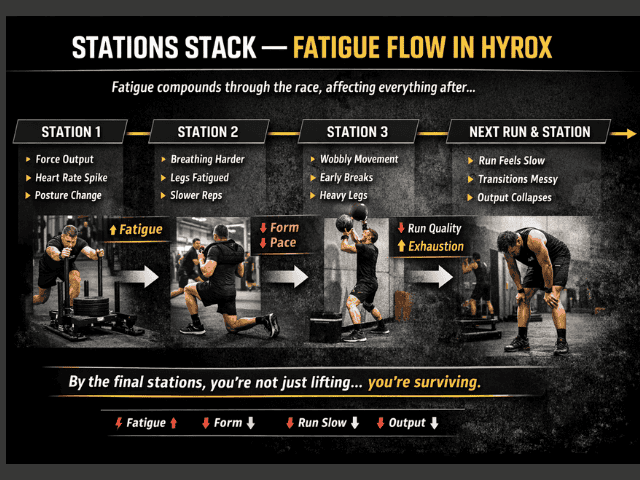
📉 This is where most races quietly fall apart.
Each station:
- adds fatigue
- alters breathing
- changes posture
- impacts the next run
By lunges and wall balls…
…you’re not testing strength.
You’re testing repeatability under accumulated fatigue.
That’s the difference.
The 3 Types of Strength You Actually Need for HYROX
1. Sled Strength
💥 Biggest separator.
What matters:
- force under fatigue
- body position when tired
- consistent pressure
- maintaining output late
Common mistake:
Training sleds fresh only.
👉 If sleds wreck you, check your performance against the HYROX station split benchmarks before changing your training.
2. Repeated Effort Strength
🔁 Where most races slow.
Shows up in:
- lunges
- wall balls
What matters:
- pacing
- breathing
- repeatable sets
- avoiding early failure
Mistake:
Going too hard early → falling apart late.
3. Grip and Carry Strength
🧱 Quiet limiter.
Shows up in:
- farmer’s carry
- sandbag control
What matters:
- grip endurance
- posture
- staying relaxed under load
Mistake:
Grip fails → pace collapses.
If your hands are the weak point rather than your legs, compare the best gloves for HYROX so your race-day kit supports your grip instead of fighting it.
Common Mistakes (That Keep Strong Athletes Slow)

- lifting heavy with long rest only
- random circuits with no progression
- ignoring sled specificity
- no pacing strategy on high-rep stations
- never training late-race fatigue
👉 These all feel productive.
They’re not.
How To Diagnose Whether Stations Are Really Costing You Time
Before changing your training:
1. Do Stations Break Your Rhythm?
Runs steady, stations messy → this limiter.
2. Do You Fall Apart Late?
Lunges / wall balls collapse late → repeatability issue.
3. Does It Spill Into The Run After?
🚨 Biggest signal.
Station fatigue ruining the next run = strength endurance problem.
👉 Use the HYROX station split benchmarks alongside How to Improve Your HYROX Time to confirm before you change anything.
If stations are what wreck your race, fix that first.
Get the 14-Day HYROX Kickstart and build better sled, lunge and wall ball durability without training everything badly.
A Complete 4-Week HYROX Strength Endurance Programme
This is a limiter block.
Not a full plan.
That matters.
The goal is simple:
Fix the thing actually costing you time.
If you need to fit this into a complete week with running, recovery and progression, use the full HYROX training plan rather than bolting random sessions onto it
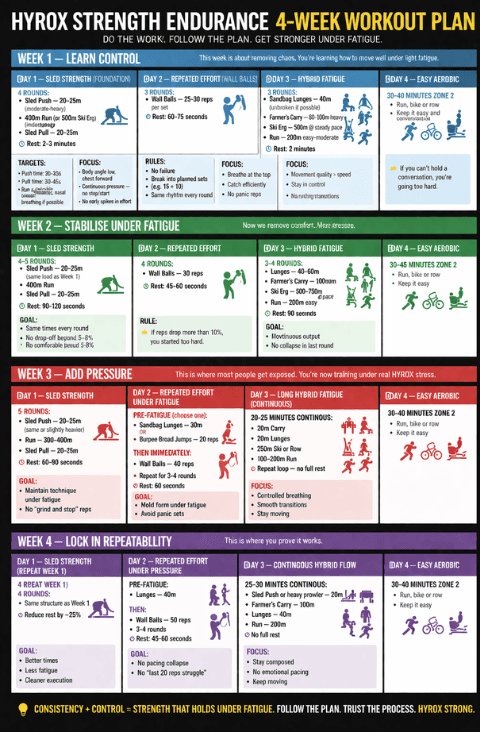
Weekly Structure
| Day | Focus | Purpose |
|---|---|---|
| Day 1 | Sled Strength | High-force output under fatigue |
| Day 2 | Repeated Effort | Wall ball and lunge repeatability |
| Day 3 | Hybrid Fatigue | Connect stations to running |
| Day 4 | Easy Aerobic | Recovery and support |
Week 1 — Learn Control
This week is about removing chaos.
You’re learning how to move well under light fatigue.
Day 1 — Sled Strength (Foundation)
4 rounds:
- Sled Push — 20–25m (moderate-heavy load)
- 400m Run (or 500m Ski Erg if indoors)
- Sled Pull — 20–25m
- Rest: 2–3 minutes
Targets:
- Push time: 20–30s
- Pull time: 30–45s
- Run: comfortable, nasal breathing if possible
Focus:
- Body angle low, chest forward
- Continuous pressure — no stop/start
- No early spikes in effort
Day 2 — Repeated Effort (Wall Balls)
3 rounds:
- Wall Balls — 25–30 reps per set
- Rest: 60–75 seconds
Rules:
- No failure
- Break into planned sets (e.g. 15 + 10)
- Same rhythm every round
Focus:
- Breathe at the top
- Catch efficiently
- No panic reps
Day 3 — Hybrid Fatigue
3 rounds:
- Sandbag Lunges — 40m (unbroken if possible)
- Farmer’s Carry — 80–100m heavy
- Ski Erg — 500m @ steady pace
- Run — 200m easy-moderate
- Rest: 2 minutes
Focus:
- Movement quality > speed
- Stay in control
- No rushing transitions
Day 4 — Easy Aerobic
- 30–40 minutes Zone 2
- Run, bike or row
👉 If you can’t hold a conversation, you’re going too hard.
Week 2 — Stabilise Under Fatigue
Now we remove comfort.
Less rest. More pressure.
Day 1 — Sled Strength
4–5 rounds:
- Sled Push — 20–25m (same load as Week 1)
- 400m Run
- Sled Pull — 20–25m
- Rest: 90–120 seconds
Goal:
- Same times every round
- No drop-off beyond 5–8%
Day 2 — Repeated Effort
4 rounds:
- Wall Balls — 30 reps
- Rest: 45–60 seconds
Rule:
👉 If reps drop more than 10%, you started too hard.
Day 3 — Hybrid Fatigue
3–4 rounds:
- Lunges — 40–60m
- Farmer’s Carry — 100m
- Ski Erg — 500–750m
- Run — 200m
- Rest: 90 seconds
Goal:
- Continuous output
- No collapse in last round
Day 4 — Easy Aerobic
- 35–45 minutes Zone 2
Week 3 — Add Pressure
This is where most people get exposed.
You’re now training under real HYROX stress.
Day 1 — Sled Strength
5 rounds:
- Sled Push — 20–25m (same or slightly heavier)
- Run — 300–400m
- Sled Pull — 20–25m
- Rest: 60–90 seconds
Goal:
- Maintain technique under fatigue
- No “grind and stop” reps
Day 2 — Repeated Effort Under Fatigue
Pre-fatigue:
- Sandbag Lunges — 30m
- OR Burpee Broad Jumps — 20 reps
Then immediately:
- Wall Balls — 40 reps
Repeat for 3–4 rounds
Rest: 60 seconds
Goal:
- Hold form under fatigue
- Avoid panic sets
Day 3 — Long Hybrid Fatigue (Continuous)
20–25 minutes continuous:
- 20m Carry
- 20m Lunges
- 250m Ski or Row
- 100–200m Run
Repeat loop — no full rest
Focus:
- Controlled breathing
- Smooth transitions
- Stay moving
Day 4 — Easy Aerobic
- 30–40 minutes Zone 2
Week 4 — Lock In Repeatability
This is where you prove it works.
Day 1 — Sled Strength (Repeat Week 1)
4 rounds:
- Same structure as Week 1
- Reduce rest by ~25%
Goal:
- Better times
- Less fatigue
- Cleaner execution
Day 2 — Repeated Effort Under Pressure
Pre-fatigue:
- Lunges — 40m
Then:
- Wall Balls — 50 reps
3–4 rounds
Rest: 45–60 seconds
Goal:
- No pacing collapse
- No “last 20 reps struggle”
Day 3 — Continuous Hybrid Flow
25–30 minutes continuous:
- Sled Push or heavy prowler — 20m
- Farmer’s Carry — 100m
- Lunges — 40m
- Run — 200m
No full rest
Focus:
- Stay composed
- No emotional pacing
- Keep moving
Day 4 — Easy Aerobic
30–40 minutes Zone 2
🔁 Re-Test Your Station Performance
After a few weeks, your stations should feel more controlled — not just survivable.
👉 Check your HYROX time again
If your stations feel better but your race time is not improving:
you may now be limited by running, pacing, or fatigue.
👉 Return to the HYROX Performance System
and adjust your focus.
If it is pacing, go straight to the HYROX pacing strategy guide and clean up your race execution next.
Progression Rule — This Decides Whether You Improve
⚠️ Most people get this wrong.
Progress when:
- output holds across rounds
- rest decreases without collapse
- movement stays stable
- rhythm stays controlled late
Do not progress when:
- reps fall apart early
- rest carries the session
- technique breaks down
- you’re just surviving
That’s not progress.
That’s noise.
What Happens When You Fix Strength Endurance

Fixing this doesn’t just improve stations.
It improves:
- the run after each station
- transition control
- breathing recovery
- your ability to avoid late-race collapse
👉 You’re not just saving time on stations.
You’re protecting your entire race.
If you race Pro, this matters even more — the heavier division increases fatigue cost significantly. See the difference in HYROX Pro vs Open Times.
What If Strength Endurance Isn’t Your Limiter?
Then this is not your first fix.
If your race looks like:
- strong stations, fading runs
- early blow-up
- no clear strength anywhere
👉 Go back to your HYROX Times breakdown, then use How to Improve Your HYROX Time to identify the real limiter.
If it’s running…
👉 Use a proper HYROX running programme.
Wrong block = wasted work.
Ready to stop feeling strong in the gym but slow in the race?
Start the 14-day Kickstart and turn this limiter into something you can actually improve.
📈 What To Do Next
Follow the system:
Step 1 — Diagnose
Start with your HYROX times
Step 2 — Identify the limiter
Use How to Improve Your HYROX Time
Step 3 — Apply the block
Run this plan properly
Step 4 — Build your full structure
Plug it into your HYROX training plan
That’s the order.
If Your Stations Feel Heavier Than They Should, Check Your Shoes
Your strength still matters most.
But if your shoes lack grip, stability or control, every sled push, lunge and transition costs more energy than it should.
That adds up fast.
For HYROX strength endurance, your shoe needs:
- aggressive grip for sled push and pull
- stability under fatigue (so your legs don’t collapse)
- enough cushioning to stay consistent across stations
Most athletes don’t realise this…
👉 they’re strong enough — but their setup makes every rep harder
If your stations feel heavier than they should, start here:
👉 See the best HYROX shoes for strength, grip and control
FAQs
Should I still lift heavy?
Yes.
But it won’t fix this on its own.
How often should I train sleds?
At least once per week.
Can I improve this without hurting my running?
Yes.
If running is also fading, fix it directly with a HYROX running programme.
Should beginners do this?
Only if stations are clearly the limiter.
Otherwise compare yourself properly using HYROX age group times.
Final Reality Check
You don’t need:
- more random circuits
- more gym strength
You need:
- strength under fatigue
- control under pressure
- repeatable output
Fix that…
…and your stations stop killing your race.
They start holding it together.