

Most people don’t fail in HYROX because they’re lazy.
They fail because they train hard when their body isn’t ready — and quietly ruin the next 2–3 sessions.
That’s the real cost.
Not one bad workout.
But the knock-on effect that stalls progress, trashes pacing, and shows up on race day.
You’re going to feel tired. That’s part of HYROX.
The difference is knowing what to do when it happens.
So let’s answer how to workout when tired….
Quick Answer: Should You Work Out When Tired?
Yes — most of the time. But not at full intensity.
- Train as planned → if it’s just low motivation
- Modify the session → if sleep, stress or soreness is affecting you
- Switch to recovery or rest → if fatigue is building or your body feels off
👉 The goal isn’t to skip.
👉 The goal is to adjust the demand so the session still works.
The 30-Second Fatigue Decision Rule
| Signal | Action |
|---|
| Feel lazy but body OK | Train as planned |
| Heavy but improves in warm-up | Reduce intensity |
| Poor sleep + flat | Short, controlled session |
| Warm-up worse + HR high | Stop |
| Dizzy / weak / ill | Full rest |
Key Findings
- Being tired does not automatically mean you should skip training
- Most people fail by keeping intensity too high when recovery is low
- Short, controlled sessions outperform “hero workouts” when energy is poor
- Poor fatigue management is one of the biggest reasons HYROX performance breaks down
- Consistency under imperfect conditions beats stop-start training every time
Train, Modify or Rest? Use This Quick Check
| Situation | Best Move |
|---|---|
| Low motivation, body feels fine | Train as planned |
| Heavy legs, improves after warm-up | Reduce intensity 10–20% |
| Poor sleep (1–2 nights) | Shorten session, control effort |
| Poor sleep (several nights + performance dropping) | Recovery session or rest |
| High resting heart rate, dizziness, illness | Stop and recover |
| Warm-up feels worse and worse | Do not force the session |
The rule most people miss:
Tired does not mean stop.
It usually means:
👉 Train differently.
What Kind of Tired Are You? (This Changes Everything)
Treat all fatigue the same and you’ll get poor results.
1. Low Motivation
You don’t feel like training, but physically you’re fine.
Move: Start the warm-up. Reassess after 10 minutes.
2. Sleep-Deprived
Recovery is compromised.
Move: Reduce intensity. Avoid max effort. Keep it short.
3. Muscular Fatigue
Heavy legs, soreness, reduced power.
Move: Zone 2 cardio, mobility, technique work, or upper-body focus.
4. Systemic Fatigue
Everything feels off. Mood low. Warm-up feels bad.
Move: Back off properly. This is not a push-through day.
If You’re Tired Because of Poor Sleep
This is where most people get it wrong.
- 1 poor night → train, adjust intensity
- 2–3 poor nights → shorten session, control effort
- Multiple poor nights + performance dropping → back off
👉 Forcing intensity here is where progress stalls.
A controlled session will always beat a forced one.
What “Reducing Intensity” Actually Means (HYROX Benchmarks)
This is where most advice falls apart — no specifics.
Here’s what it actually looks like:
| Session Type | Normal | When Tired |
|---|---|---|
| Run pace | 5:00/km | 5:30–5:45/km |
| Sled push | Competition load | -10–20% load |
| Wall balls | 25 unbroken | 10–15 reps |
| Intervals | 90–95% effort | 70–80% effort |
👉 You’re not guessing. You’re adjusting with intent.
If you’re unsure what “normal” should be, use current HYROX times and performance benchmarks to anchor your pacing and expectations.
Why You Always Feel Tired in Training
If this is constant, something is off.
1. Your Plan Doesn’t Match Your Life
A perfect plan means nothing if you can’t recover from it.
👉 Fix this with a structured HYROX training plan that fits your actual schedule — not an ideal one.
Fix: Remove one hard session before removing consistency.
2. You’re Training Hard Too Often
Too much “medium-hard” work = constant fatigue.
👉 This is the most common HYROX mistake.
Fix: Cap hard sessions at 2 per week.
3. You’re Under-Fuelled
Signs:
- Heavy legs
- Flat sessions
- Poor repeat effort
- Cravings
- Low mood
Fix: Add carbs before and after demanding sessions.
4. Your Easy Days Aren’t Easy
If everything feels like a test, nothing works properly.
Fix: At least one session should feel easy.
5. Life Stress Is Draining You
Your body doesn’t separate:
- Work stress
- Poor sleep
- Training load
👉 It all stacks.
Fix: Reduce volume, not movement.
What Happens If You Get This Wrong
This is where performance actually drops.
- You carry fatigue into race day
- Your run pace drops after halfway (often 10–20 sec/km)
- Transitions slow by 5–10 seconds each
- Wall balls break earlier and more often
- You lose minutes, not seconds
👉 That’s the difference between average and competitive.
If you’re not sure where you’re leaking time, use HYROX station split benchmarks to pinpoint exactly where fatigue is costing you.
The Smart Way to Train When You’re Tired
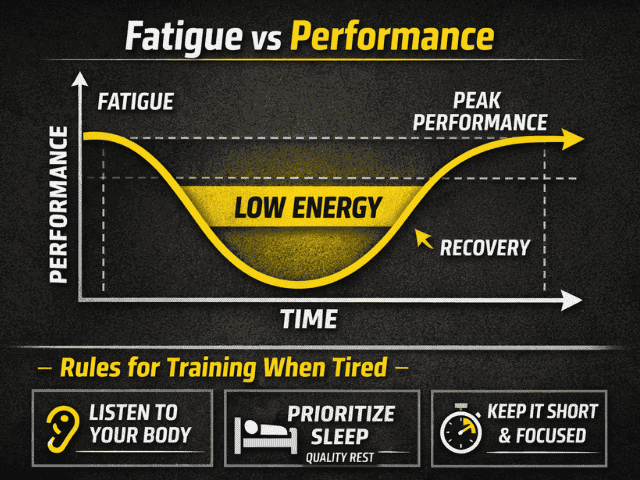
This is where progress is protected.
1. Reduce Intensity Before Frequency
Do not skip. Adjust.
- Drop load 10–20%
- Cut sets
- Reduce session length
- Remove max effort
2. Short Sessions Beat Skipped Sessions
A 30–40 min session can:
- Maintain strength
- Protect routine
- Improve mood
3. Keep One Goal Per Session
Pick one:
- Maintain strength
- Aerobic work
- Movement quality
- Pacing practice
4. Train by Effort, Not Ego
👉 Stop chasing numbers from your well-rested self.
5. Stop Trying to Win Every Workout
Some sessions are there to:
- Maintain
- Keep rhythm
- Avoid regression
That still counts.
How to Modify Your Workout (Real Examples)
If Your Session Was Strength
- Reduce load: 10–20%
- Stop 2–4 reps before failure
- Cut sets by 25–40%
If Your Session Was Intervals
Swap for:
- 20–30 mins Zone 2
- Controlled breathing
If Your Session Was HYROX-Based
Adjust like this:
- Keep structure
- Reduce load
- Reduce volume 30–50%
- Drop run pace
Example:
- 1km run → easy
- Sled push → lighter
- Wall balls → smaller sets
👉 You’re still building race skill without wrecking recovery.
To understand what “race skill” should feel like, anchor your pacing against what a good HYROX time actually looks like.
Minimum Effective Workouts (When You’re Exhausted)
Option 1: 20-Minute Reset
- 5 min easy cardio
- 10 min light circuit
- 5 min mobility
Option 2: Low-Energy Strength
Pick:
- 1 lower
- 1 push
- 1 pull
- 1 core
2–3 controlled sets each.
Option 3: HYROX Low-Energy Session
- Easy run
- Light sled
- Lunges
- Ski/row
👉 Stop while it still feels good.
Real Scenario: You Slept 4–5 Hours
What most people do:
- Force intervals
- Feel awful
- Ruin next 2 days
What you should do:
- 30 min Zone 2
- Light technique work
- Leave fresh
👉 That’s how consistency is built.
The Biggest Mistakes When Training Tired
1. Treating Every Session Like a Test
That’s not discipline. That’s poor judgement.
2. Skipping Too Often
One missed session is fine.
A pattern kills progress.
3. Programme Hopping
The issue is usually recovery, not the plan.
4. Ignoring Running Efficiency
Fatigue destroys:
- Pacing
- Transitions
- Efficiency
👉 This is where races are lost, not won.
5. Confusing Maintenance With Failure
Holding performance = progress when fatigued.
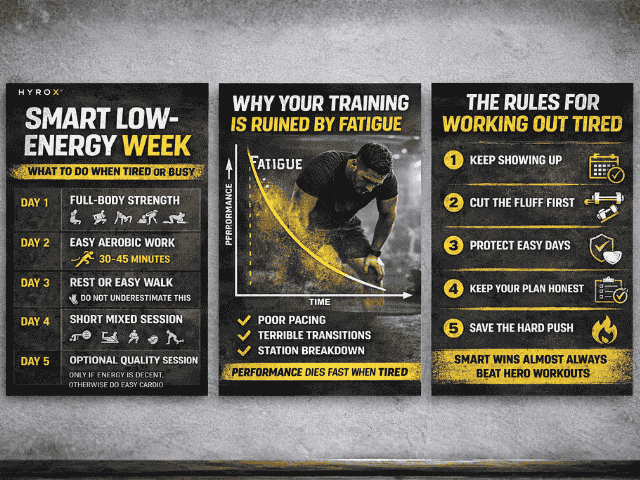
A Simple Low-Energy Training Week That Works
Here’s a simple visual breakdown you can follow when energy is low:
If life is chaotic:
- Day 1: Full-body strength (controlled)
- Day 2: Easy aerobic (30–45 min)
- Day 3: Rest / walk
- Day 4: Short mixed session
- Day 5: Optional quality (only if energy is good)
👉 If not, keep it easy.
How This Applies to HYROX
HYROX exposes poor fatigue management fast.
Because it’s repeated effort:
- Run
- Station
- Repeat
When fatigue isn’t managed:
- Run pace drops early
- Transitions slow
- Sleds feel heavier
- Wall balls fall apart
👉 It’s not just fitness. It’s fatigue control.
That is exactly why a HYROX training plan you can actually repeat matters more than a hard-looking week you cannot recover from. If fatigue is coming from heavy stations breaking you down, build from HYROX strength endurance.
If your running falls apart once you are tired, use the HYROX running programme. And if you’re unsure whether you’re underperforming or just misreading your effort, check your context against the complete HYROX times and benchmarks guide.
It’s also why HYROX percentiles can be so misleading when fatigue changes how your race unfolds, because a field-based label will not show you where your pacing, transitions or station quality actually collapsed.
Use:
…to identify exactly where you’re losing performance.
Use These Real Benchmarks to Adjust
Scale down if:
- Warm-up feels harder than normal
- Weights feel heavy immediately
- Heart rate spikes early
- Coordination feels off
Stop if:
- Warm-up gets worse
- Technique breaks early
- Dizziness or weakness appears
Tools That Actually Help
- Simple training log
- Effort tracking (watch)
- Bedtime alarm
- Carbs around training
- Electrolytes (if needed)
👉 These support decisions. They don’t replace them.
When You Should Stop Pushing
Be cautious if:
- Fatigue lasts weeks
- Performance is dropping everywhere
- Niggles are building
- Mood is worse
- Sleep is getting worse
👉 That’s not weakness.
👉 That’s a system problem.
Why Light Sessions Work Better Than You Think
They:
- Improve blood flow
- Boost energy
- Reduce stiffness
- Maintain consistency
👉 Not every session needs to be hard to count.
Wrap Up
If you’re tired, the goal isn’t to prove toughness.
It’s to make the right call.
Train hard when recovery supports it.
Train smart when it doesn’t.
Because:
👉 Consistency beats intensity — especially in HYROX.
FAQs
Should I skip a workout if I’m tired?
No. Adjust before skipping.
Is it bad to train on low sleep?
One night is fine. Several = adjust.
What’s the best workout when tired?
Short, controlled sessions.
Can you still improve when training tired?
Yes — if you manage load properly.
Sleep or workout?
Severe fatigue = sleep.
Mild fatigue = train smart.