

You don’t need more training.
You need the right training for your limiter.
If your HYROX time isn’t moving, this is why:
- you’re training everything
- but fixing nothing
And that’s exactly why:
- your pacing still fades
- the same stations still break you
- your result barely changes race to race
This isn’t effort.
It’s misalignment.
Fix that, and your next race looks completely different.
Let’s show you exactly how to improve your HYROX time.
⚡ Key Findings (Read This First)
- HYROX performance is driven by four systems, not workouts
- Most athletes train broadly and improve slowly
- Your biggest gains come from fixing one limiter first
- 4–6 weeks of focused work beats 12 weeks of mixed training
- Pacing and fatigue resistance decide your finish time
👉 If you haven’t grounded your result yet, start with a proper breakdown of your HYROX times and what they actually mean before changing anything.
Why Your HYROX Time Isn’t Improving
You’re doing:
- running
- strength
- circuits
- intervals
That looks right.
It feels productive.
It’s not specific enough.
What’s Actually Happening
- your running improves slightly
- your strength improves slightly
- your conditioning improves slightly
But under race fatigue?
Nothing holds.
So you repeat:
- same pacing mistakes
- same station slowdowns
- same late-race drop
Different race.
Same outcome.
If that sounds familiar, you’re not alone.
Most people get stuck here because they don’t understand what a good HYROX time actually looks like for their level… or how far off they really are.
🧠 The HYROX Performance System (What Actually Drives Your Time)
Stop thinking in exercises.
Start thinking in systems.
Every HYROX result comes down to four things:
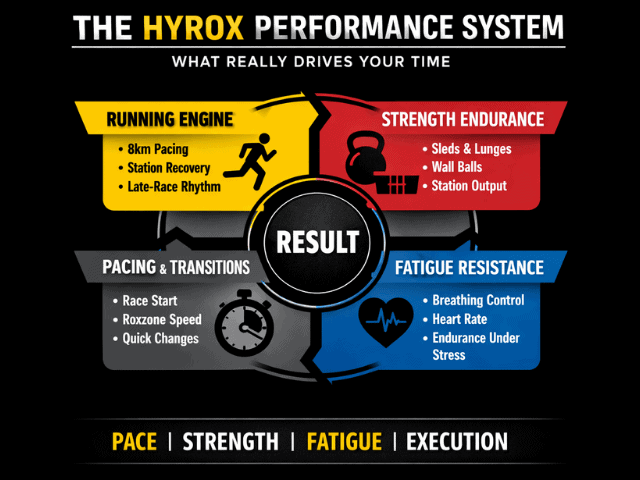
1. Running Engine 🏃
Your ability to:
- hold pace across all 8km
- recover after stations
- maintain rhythm late-race
Reality check:
- If your pace drops 10–15+ sec/km after halfway → this is your limiter
If this fails → everything slows.
2. Strength Endurance 🏋️
Your ability to:
- handle sleds, lunges, wall balls under fatigue
- maintain output instead of stopping
- avoid long station breaks
Reality check:
- If stations spike HR or force rest → you’re losing minutes, not seconds
👉 If you’re not sure what “good” looks like here, compare your output against realistic HYROX station split benchmarks.
If this fails → stations dominate your race.
3. Fatigue Resistance 🔁
This is where most athletes fall apart.
It’s not just fitness.
It’s how well your systems hold together when it matters:
- breathing control
- heart rate stability
- recovery between efforts
Reality check:
- If your race drops hard after 25–35 minutes → this is your issue
If this fails → your race unravels.
4. Pacing & Transitions ⏱️
This is the hidden layer.
You don’t lose races here.
You leak them.
- going out too hard
- poor Roxzone control
- slow transitions
Reality check:
- If your first 2km is your fastest → pacing problem
This is free time most people ignore.
👉 If that’s you, go deeper with this HYROX pacing strategy guide and fix your race execution properly.
Diagnose Your Limiter (Be Honest)
Before you change anything, answer this:
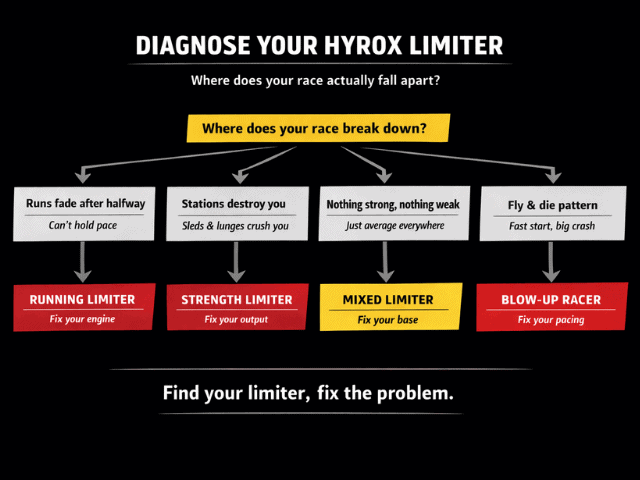
Where does your race actually fall apart?
- Runs fade hard after halfway → Running limiter
- Stations break your rhythm → Strength limiter
- Nothing terrible, nothing strong → Mixed limiter
- Strong start, big slowdown → Blow-up racer
If you’re unsure:
You haven’t analysed your race properly.
Go back and review your full HYROX time breakdown before guessing.
Want to improve your HYROX time without fixing the wrong thing first?
Get the 14-Day HYROX Performance Kickstart and start with the limiter most likely holding your race back.
Which Athlete Are You?
This is where it clicks.
You don’t need a better plan.
You need the right plan.
Running Limiter
You feel:
- strong early
- but your runs fall apart mid-race
- stations feel manageable… until they don’t
Reality:
Your aerobic engine isn’t holding under fatigue.
Strength Limiter
You feel:
- fine on runs
- but stations destroy your rhythm
- sleds and lunges cost you heavily
Reality:
Your strength endurance isn’t HYROX-ready.
If that sounds like you, go straight to the HYROX strength endurance block and fix the station repeatability problem before you touch anything else.
Mixed Limiter
You feel:
- nothing is terrible
- but nothing is strong
Reality:
You’re decent everywhere.
Not good enough anywhere.
Blow-Up Racer
You feel:
- great early
- then everything collapses
Reality:
Your pacing is the problem.
Not your fitness.
That means you need a proper HYROX pacing strategy, not more random fitness work.
What To Do Based On Your Limiter
This is where most people go wrong.
They stay generic.
You won’t.
If You’re a Running Limiter
Focus: fatigue-resistant aerobic output
Train:
- compromised running (post-station runs)
- threshold efforts
- repeatable pacing under fatigue
Example session:
- 1km run (controlled)
- 50 wall balls
- 1km run
- 50 lunges
- 1km run
Target:
Hold pace within ±5–8 sec/km
Use the HYROX running programme to fix this area.
If You’re a Strength Limiter
Focus: sustained output under load
Train:
- longer station sets
- reduced rest
- loaded carries + lunges
Example session:
- sled push intervals (short rest)
- walking lunges
- farmer’s carry holds
Target:
Reduce station rest by 20–30% in 4 weeks
To do that properly, run this 4-week HYROX strength endurance programme built for sleds, lunges, carries and wall balls under fatigue.
If You’re a Mixed Limiter
Focus: raise your floor
Train:
- hybrid sessions
- moderate intensity
- consistent structure
Example session:
- 800m run
- ski erg
- burpee broad jumps
- repeat
Target:
No drop-off across full session
The 4-Week HYROX training plan will guide you though this.
If You’re a Blow-Up Racer
Focus: control
Train:
- negative split sessions
- controlled starts
- pacing discipline
Example session:
- 1km easy
- 1km steady
- 1km strong
Repeat.
Target:
Always finish faster than you start
Use this HYROX pacing strategy to maximise your results.
You don’t need a random week of hard sessions.
Get a practical 14-day HYROX structure built to help you fix the right problem first.
🗓️ Your Weekly HYROX Structure (Built Around Your Limiter)
This is what your week should actually look like when it’s built properly.
Stop copying random sessions.
Build your week around what actually needs fixing.
This is where a structured HYROX training plan becomes useful, because once you know your limiter, your week should reflect it clearly instead of mixing random hard sessions together.
If your running is the real leak, plug this into the HYROX running programme. If stations are where you are bleeding time, build from HYROX strength endurance. If you still are not sure whether your result is actually weak for your level, go back to your full HYROX time breakdown before changing anything.
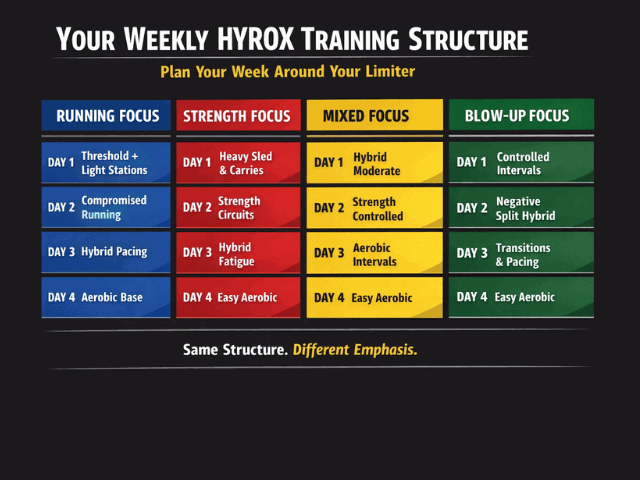
Running Focus Week
- Day 1 — Threshold + light stations
- Day 2 — Compromised running
- Day 3 — Hybrid pacing
- Day 4 — Aerobic base
Strength Focus Week
- Day 1 — Heavy sled + carries
- Day 2 — Strength endurance circuits
- Day 3 — Hybrid fatigue
- Day 4 — Easy aerobic
Mixed Focus Week
- Day 1 — Hybrid moderate
- Day 2 — Strength controlled
- Day 3 — Aerobic intervals
- Day 4 — Easy aerobic
Blow-Up Focus Week
- Day 1 — Controlled intervals
- Day 2 — Negative split hybrid
- Day 3 — Transitions + pacing
- Day 4 — Easy aerobic
Same structure.
Different emphasis.
That’s what works.
👉 If you want this mapped properly into a system you can follow, build from a structured HYROX training plan that matches your limiter.
📈 Progression Logic (This Is Where You Actually Improve)
Most people train harder.
You need to train better.
Every week:
- reduce unnecessary rest
- improve pacing control
- increase consistency under fatigue
Simple Rule
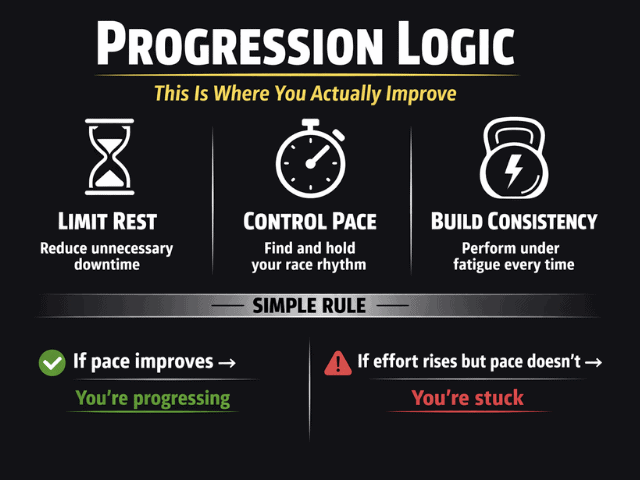
- If pace improves → you’re progressing
- If effort rises but pace doesn’t → you’re stuck
⚠️ Where Most Athletes Still Go Wrong
Even with structure:
- jumping between training styles
- chasing intensity
- ignoring pacing
- copying elite sessions
That’s how you stall.
Where You’re Actually Losing Time
You don’t need more volume.
You need clarity.
Ask:
- where is time leaking?
- what breaks your rhythm?
- what causes your slowdown?
Most athletes realise the same thing:
They’ve been training the wrong limiter.
🚀 Your Next Step (This Is Where It Changes)
Right now, you’ve got clarity.
That’s rare.
Most people stop here.
They go back to mixed training.
They repeat the same race.
Don’t do that.
👉 Follow a structured HYROX training plan that matches your limiter
Start with a complete HYROX training plan built for real performance, then refine it based on what you’ve identified here.
Commit for 4–6 weeks.
No switching.
No guessing.
Because once you fix the right problem…
Everything else starts improving with it.
FAQ (Quick Answers)
How long does it take to improve HYROX time?
4–6 weeks of focused limiter training can produce noticeable gains if applied properly.
What is the biggest mistake in HYROX training?
Training everything equally instead of fixing your weakest system.
Should I train running or strength more?
Whichever is limiting your performance.
That’s the only one that matters right now.
Do I need a full HYROX training plan?
Yes — but only once you know what to prioritise.
Otherwise, it stays generic.
Bottom Line
You don’t need more sessions.
You need better alignment.
- Fix your limiter
- Train with intent
- Execute properly
That’s how your HYROX time actually drops.